
You have replaced a drifting pad once already, and you do not want to pay for the same fault again?
Last updated: 14 November 2026 | Category: Controller Comparisons | Reading time: about 11 minutes | Tested with Chrome/Edge, Gamepad API
Quick Answer
Buy for your platform first, then for the sensor. All five picks in this post use Hall effect sticks, and each one lists its platforms in its manual or in the 8BitDo table. No pick here is a first-party pad. Test the pad you already own first, then buy the pick that lists your platform.
Check the pad you already own
No download. No account. Data stays in your browser.
What under $50 means here
Budget means under $50 at typical retail in this post. That is a definition, not a price claim for any single model. Prices are omitted because listings conflict for the same model. No price in this post is buying advice, and the picks table has no price column.
What drift is comes down to a stick that reports movement while your hands are off it. A Hall effect stick reads position with a magnet and no contact in the sensing path, so the wear cause of drift is resisted. That is a real advantage, not a promise that drift is impossible.
Why first-party pads are not picks
The PS5 DualSense, the Xbox Wireless Controller, and the Switch Pro Controller all use potentiometer sticks. iFixit states this plainly in its Switch 2 teardown: “All three major console manufacturers are using potentiometer-based joysticks” (Tier 2, iFixit Switch 2 teardown). Nintendo also confirmed the Switch 2 does not use Hall effect sensors.
A potentiometer reads position through a wiper that slides on a resistive pad. That contact wears with use, and the wear changes the reading at rest. So a budget first-party pad is not a no-drift pick in this post.
How Hall sticks differ in plain words
Hall sticks read position with a magnet and no contact in the sensing path, while potentiometer sticks read position through a wiper that wears. A potentiometer is a variable resistor that forms a variable voltage divider. Moving the stick moves a conductive wiper against a resistive contact pad, which varies the resistance and therefore the output voltage. The controller reads that voltage as a position. Two potentiometers per stick, one for X and one for Y (Tier 2, iFixit).
The resistive contact pads wear down from friction. Every stick movement removes a minuscule amount of material. Once the resistance value of the neutral position changes, the controller reads a different voltage than expected while stationary and interprets it as input. That is drift (Tier 2, iFixit).
A Hall effect stick works differently. The wiper is replaced by a magnet and the resistive strip by a flat conductor (Hall element) sensitive to magnetic fields. As the stick moves, the sensor detects the magnetic field change and interprets it as movement. No physical contact in the sensing path, so no friction wear in the sensing path (Tier 2, iFixit Hall effect wiki).
iFixit states Hall effect joysticks could hypothetically last the entire lifetime of the controller, while potentiometers are nearly guaranteed to fail eventually (Tier 2 with Tier 3 framing, iFixit).
Hall effect is not a promise that drift is impossible. Even Hall effect sticks can develop drift from other causes. A weak centering spring is one cause, and calibration or mechanical issues can still occur (Tier 3, spring return behaviour).
TMR (tunneling magnetoresistance) is a related but distinct magnetic sensing approach, newer than Hall effect, and less susceptible to magnetic interference than Hall effect (Tier 3, trade press). No pick here is sold on TMR.
How Hall sticks differ is explained in depth in the sensor comparison post.
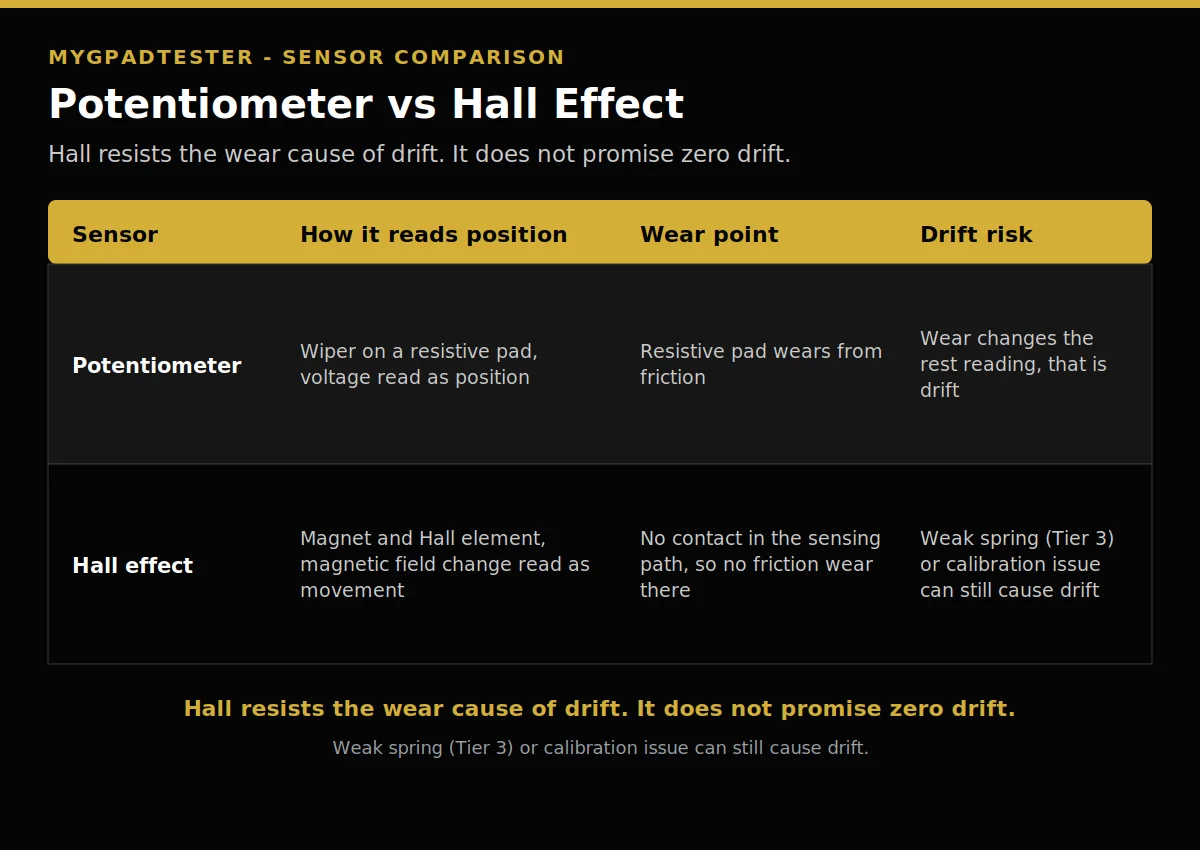
| Sensor | How it reads position | Wear point | Drift risk |
|---|---|---|---|
| Potentiometer | Wiper on a resistive pad, voltage read as position | Resistive pad wears from friction | Wear changes the rest reading, that is drift |
| Hall effect | Magnet and Hall element, magnetic field change read as movement | No contact in the sensing path, so no friction wear there | Weak spring (Tier 3) or calibration issue can still cause drift |
The 5 picks under $50
Five picks for budget readers. Platform fit first, sensor type second. No price column. Every spec below comes from the official manual, or from the 8BitDo table.
| Pick | Sensor type | Triggers | Connection | Platforms | Limit |
|---|---|---|---|---|---|
| 8BitDo Ultimate 2C Wireless (PC) | Hall Effect | Linear (Hall Effect) | 2.4G (Windows), Bluetooth (Android), wired (Windows) | Windows, Android | Check the exact variant name, the Bluetooth Switch variant has digital triggers |
| GameSir G7 SE | Hall Effect | Analog, Hall Effect magnetic sensors | Wired USB-C, 3 m cable | Xbox Series X|S, Xbox One, Windows 10/11 | Wired only, no wireless mode |
| GameSir Nova Lite | Hall Effect | Analog (manual) | Tri-mode: 2.4G, Bluetooth, USB-C wired | Windows 10/11, Switch, Android, iOS, Steam Deck | Triggers are analog in the manual, Hall-Linear is Tier 3 only |
| GameSir T4 Kaleid | Hall Effect | Analog, Hall Effect magnetic sensors | Wired USB-C, 2 m cable | PC (Windows), Switch, Android TV Box | No Xbox and no PlayStation support |
| 8BitDo Ultimate 2C Wired | Hall Effect | Hall Effect | Wired USB-C, detachable cable | Windows 10 and above, Android 9.0 and above | Wired only, Windows and Android only |
Footnote: prices are omitted because listings conflict. Budget means under $50 at typical retail as a definition, not a price claim for any single model. Hall effect is not drift-proof. A weak centering spring or calibration issue can still cause drift (Tier 3, spring return behaviour).
Pick 1: 8BitDo Ultimate 2C Wireless (PC)
The PC pick for wireless and wired in one pad. The 8BitDo table lists Windows and Android, with 2.4G on Windows, Bluetooth on Android, and wired on Windows (Tier 2, manufacturer source). The sticks are Hall Effect. The triggers are Linear (Hall Effect), per the same table (Tier 2, 8BitDo comparison table).
The table lists a polling rate of 2.4G / Wired 1000 Hz. 1000 Hz is a 1 ms report interval (Tier 1 maths). 8BitDo marks the figure as ideal environment lab data. Check the polling rate in the browser if you want your own reading. A browser result is browser observed, not a hardware certificate.
Variant warning. “Ultimate 2C” covers three separate models, and the trigger type differs by variant. The Bluetooth Switch variant, model BX60C, has digital triggers, not Hall triggers.
Pick 2: GameSir G7 SE
The Xbox pick. The official manual lists Xbox Series X|S, Xbox One, and Windows 10/11 (Tier 2, official manual). It is wired, with a 3 m detachable USB-C cable (Tier 2, official manual). The sticks are Hall Effect. The analog triggers use Hall Effect magnetic sensors (Tier 2, GameSir G7 SE manual).
The manual also lists 2 mappable back buttons with quick latches, 4 rumble motors, and GameSir Nexus software (Tier 2, official manual). Do not confuse the G7 SE with the G7 HE. The G7 HE is a separate model, and its specs do not belong in this row.
Pick 3: GameSir Nova Lite
The pick for one pad across many platforms. The manual lists Windows 10/11, Nintendo Switch, Android, iOS, and Steam Deck (Tier 2, official manual). It connects in three modes: 2.4G wireless, Bluetooth, and USB-C wired (Tier 2, official manual). The joysticks are Hall Effect, with up to 5 million cycles (Tier 2, GameSir Nova Lite manual).
That cycle figure is the manufacturer’s durability figure. It is not a drift-free guarantee. The battery is 600 mAh, with up to 10 hours of playtime and about 2 hours of charging (Tier 2, official manual).
Trigger note. The manual spec table lists the triggers only as “Analog Triggers”. It does not say Hall triggers. A separate GameSir spec sheet reproduced by retailers lists the trigger type as Hall-Linear (Tier 3).
Pick 4: GameSir T4 Kaleid
The wired pick for PC and Switch readers, with a transparent body and RGB lighting. The manual lists PC (Windows), Nintendo Switch, and Android TV Box (Tier 2, official manual). It connects by wired USB-C, with a 2 m cable included (Tier 2, official manual). The sticks are Hall Effect. The triggers use Hall Effect magnetic sensors, described as precision-tuned analog triggers (Tier 2, GameSir T4 Kaleid manual).
The manual also lists two programmable macro back buttons, a 6-axis gyro, dual rumble motors, and customizable RGB lighting (Tier 2, official manual). The limit is plain. There is no Xbox and no PlayStation support. The manual lists PC, Switch, and Android TV Box only.
Pick 5: 8BitDo Ultimate 2C Wired
The wired pick for PC and Android readers who want a simple cable connection and no battery. The manual lists Windows 10 and above, and Android 9.0 and above (Tier 2, official manual). It connects by wired USB-C, with a detachable cable (Tier 2, official manual). The manual lists Hall Effect joysticks and triggers. It also lists a 1000 Hz polling rate and remappable L4/R4 bumpers (Tier 2, 8BitDo Ultimate 2C Wired manual).
1000 Hz is a 1 ms report interval (Tier 1 maths). One review blog disagreed on the triggers. The review described a wireless model with a 2.4 GHz dongle and a battery, so it does not describe this wired model. The manual wins.
How to choose by platform
Xbox readers have one pick here, the GameSir G7 SE. No other pick lists Xbox. Do not buy the T4 Kaleid for Xbox.
PC readers have the widest choice. The 8BitDo Ultimate 2C Wireless (PC) covers Windows by 2.4G and wired. The G7 SE, the T4 Kaleid, and the 8BitDo Ultimate 2C Wired cover Windows by wire. The Nova Lite covers Windows 10/11 in tri-mode.
Switch readers have two picks, the Nova Lite in tri-mode and the T4 Kaleid by wire. The Bluetooth Switch variant of the 8BitDo Ultimate 2C is not a pick. It has digital triggers, not Hall triggers. iOS and Steam Deck readers have one pick, the Nova Lite.
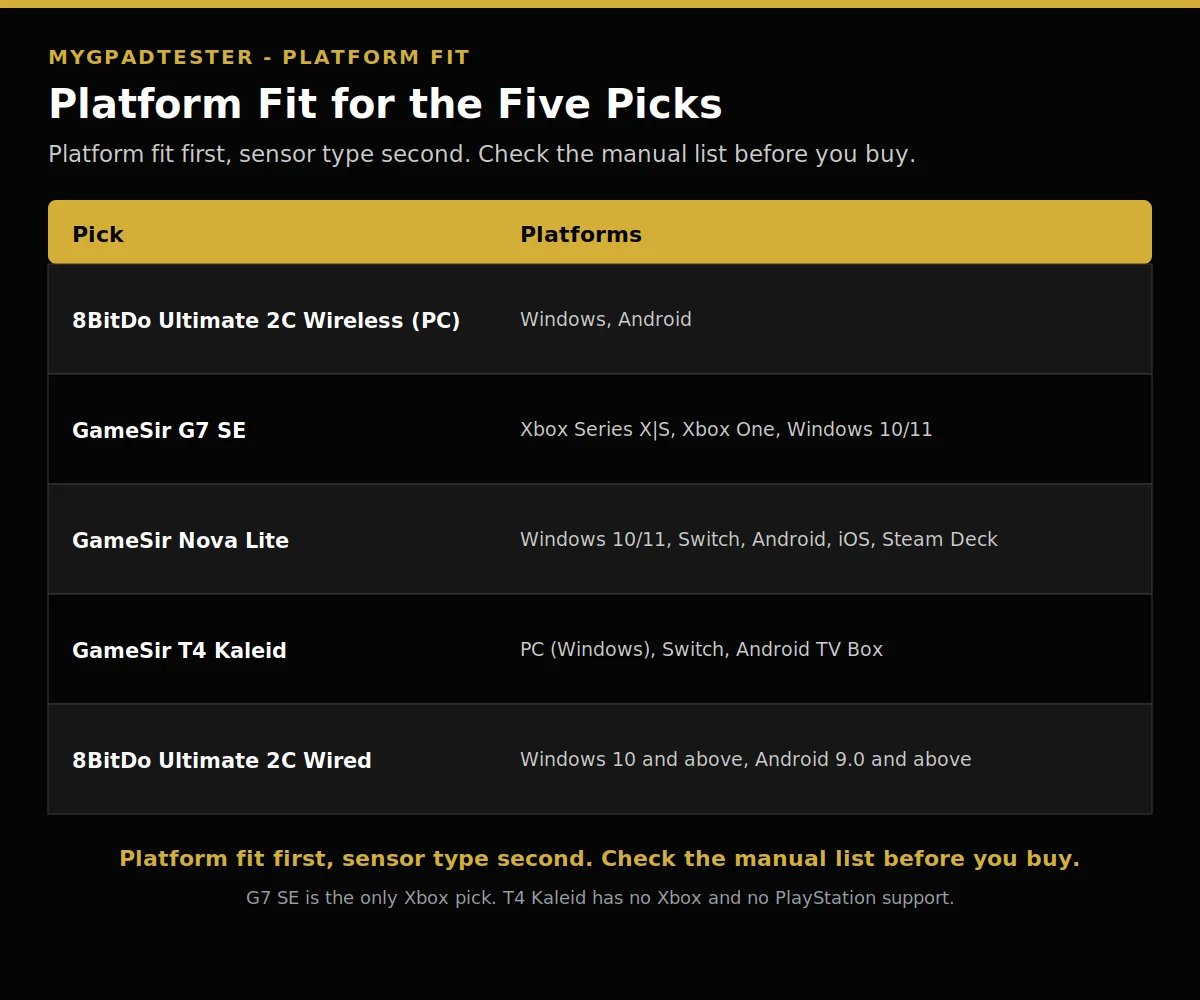
| Pick | Platforms |
|---|---|
| 8BitDo Ultimate 2C Wireless (PC) | Windows, Android |
| GameSir G7 SE | Xbox Series X|S, Xbox One, Windows 10/11 |
| GameSir Nova Lite | Windows 10/11, Switch, Android, iOS, Steam Deck |
| GameSir T4 Kaleid | PC (Windows), Switch, Android TV Box |
| 8BitDo Ultimate 2C Wired | Windows 10 and above, Android 9.0 and above |
What to check before you buy
Check the exact variant name first. “Ultimate 2C” covers three separate models, and the trigger type differs by variant. The box and the listing must say Wireless (PC) or Wired, not Bluetooth.
Check the platform list in the manual next. A store listing can be wrong. If your platform is not in the manual list, do not buy the pad for that platform.
Check the trigger type as listed, not as assumed. Hall sticks do not mean Hall triggers. The Nova Lite manual lists analog triggers only.
Test the pad you already own before you spend money. The drift test method is the method this site uses. Put the pad flat and untouched for 30 to 60 seconds. Read the result on the house drift scale, labelled tester convention every time, never a vendor specification. Flickers within 0.02 to 0.03 is normal noise. A steady offset of 0.05 to 0.10 is mild. Above 0.10 or creeping is clear drift. Random jumps mean debris, a loose stick, or a failing sensor. Retest with the same reading in the same browser on the same connection before and after each change, one variable at a time.
No drift-failure rate, lifetime estimate, or independent latency result exists for any pick in the sources checked.
What a Hall stick does not fix
A Hall stick does not fix a weak centering spring. The spring returns the stick to centre, and a weak spring can leave the stick off centre even when the sensor reads cleanly (Tier 3, spring return behaviour). It does not fix calibration either. A wrong centre point still reads as input, whatever the sensor type. Recalibrate per the manual, then retest.
A Hall stick does not fix snapback. Snapback is a spring return behaviour, and Hall sensing does not remove it. Snapback vs Stick Drift is the Day 12 Post 1 guide.
Related Tools
- Polling Rate Test
- Vibration Test
- Trigger Test
- Stick Drift Test (pillar, highlighted)
- Stick Deadzone Test
- Button Test
- Input Lag Test
- Gamepad Health Checker
Related Guides
- What Is Controller Stick Drift?
- How to Test Stick Drift Online
- Hall Effect vs Potentiometer Joystick
- Snapback vs Stick Drift, the snapback guide.
About the Author
Marcus Sterling, Lead Engineer and Founder of MyGpadTester, Austin, Texas. Profile: https://mygpadtester.com/marcus-sterling/ X: https://x.com/marcussterlin
Test the pad you already own before you spend money on a new one. Platform fit first, sensor type second.
Frequently Asked Questions
Which budget controller is best for no stick drift?
There is no single winner. Xbox readers take the G7 SE. Switch readers take the Nova Lite or the T4 Kaleid. PC readers choose by connection.
Are Hall effect controllers drift-proof?
No. Hall effect sticks can still drift from a weak centering spring or calibration and mechanical issues (Tier 3, spring return behaviour). Hall effect describes how position is sensed, not a promise that drift is impossible.
Do PS5, Xbox or Switch controllers use Hall effect sticks?
No. All three major console manufacturers use potentiometer-based joysticks (Tier 2, iFixit). Nintendo confirmed the Switch 2 does not use Hall effect sensors.
Why are there no prices in this post?
Listings conflict for the same model, so no price is used as buying advice. Budget means under $50 at typical retail as a definition, not a price claim for any single model.
What is the difference between the 8BitDo Ultimate 2C Wireless (PC) and the Bluetooth Switch variant?
They are separate models under one name. The Wireless (PC) variant has Hall Effect sticks and Linear (Hall Effect) triggers, per the 8BitDo table. The Bluetooth Switch variant, model BX60C, has digital triggers, not Hall triggers.
Does a Hall stick fix snapback?
No. Snapback is a spring return behaviour, and Hall sensing does not remove it. Snapback vs Stick Drift is the Day 12 Post 1 guide.
Should I test the controller I already own first?
Yes. Run the Stick Drift Test before you spend money, and compare the reading with the house drift scale. Flickers within 0.02 to 0.03 is normal noise, a steady offset of 0.05 to 0.10 is mild, and above 0.10 or creeping is clear drift.
Next Steps
Test the pad you already own first. If it reads clean, keep it and spend nothing. If it drifts, match your platform to the picks table, check the exact variant name, then buy the pick that lists your platform. Test the new pad the same way, and keep the reading as your baseline.