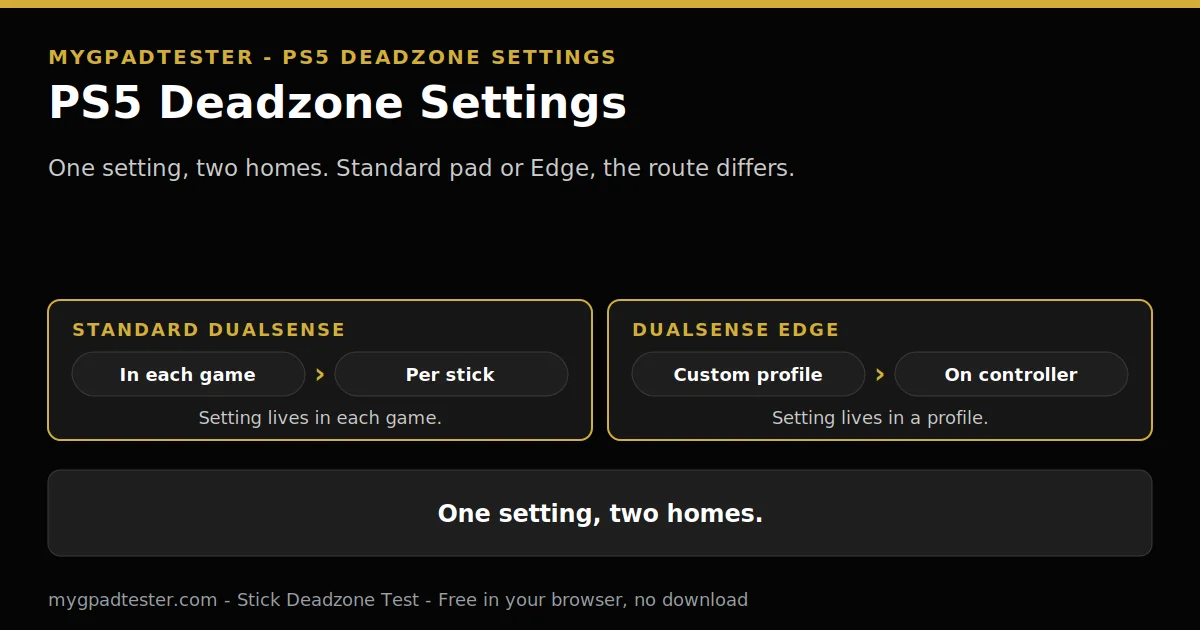
My DualSense drifts in Apex and I cannot find a deadzone setting on PS5. Is it in the game or in the system? And does the Edge have its own setting, or do I set it the same way? This post answers those questions first, then sets the deadzone once, from a measured resting reading, on the layer that fits your controller.
Last updated: 20 November 2026 | Category: Performance Optimization | Reading time: about 16 minutes | Tested with Chrome/Edge, Gamepad API
Quick Answer
A standard DualSense has no system-level deadzone slider on PS5, so the setting lives inside each game. Set it per game, per stick, starting from your measured resting reading. A DualSense Edge is different: its custom profiles carry a Stick Sensitivity and Deadzone setting that travels with the controller.
No download. No account. Data stays in your browser.
The browser test reads the raw stick value before any game, profile, or Steam Input filter. That raw reading is the starting point for every setting in this post. A standard DualSense and a DualSense Edge take different routes to the same setting, and this post keeps them apart.
Does the PS5 have a deadzone setting?
Yes, the PS5 has a deadzone setting, but on a standard DualSense it lives inside each game, not in a system menu. There is no system-level deadzone slider for a standard DualSense, so open the game controller options and set it per game, per stick, from your measured resting reading.
There is no PS5 system menu for deadzone. The menus hold controller settings, accessibility, and profile management, but not a deadzone slider for a standard DualSense. Set the deadzone in the game you play, per stick, from your measured resting reading. Then test the result in the browser tester, which reads the raw stick before the game filter.
The deadzone definition, with the three deadzone types and the platform table, lives in What Is Controller Deadzone?
Where is the deadzone setting on PS5 for Warzone, Apex or Fortnite?
On PS5 the deadzone setting for Warzone, Apex, or Fortnite lives in each game’s own controller options, with left and right sticks set separately where the game offers it. Open the game settings, find the controller section, set one stick from its measured resting reading, and test in a real match before changing the other stick.
Each game puts the setting in its own controller options. Open the game settings, find the controller section, and set one stick at a time. Set each game separately, and keep one setting per game.

| Game | Where the setting lives | Starting point | What to test after changing it |
|---|---|---|---|
| Warzone | Deadzone setting in game controller options | 0 to 5, community pattern | Play one real match, watch small aim corrections at rest |
| Apex | Deadzone setting in game controller options | 0 to 3, community pattern | Play one real match, settle deadzone before judging the curve |
| Fortnite | Deadzone setting in game controller options | 0 to 10, community pattern | Play one real match, test building and aiming separately |
All three values are community patterns, not vendor settings. Set from your own measured resting reading, starting from resting plus 0.01, then test in a real match. A setting that feels right in Warzone can feel loose or slow in Apex, because each game filters the stick its own way. The measure-first method behind these rows is the same one the FPS deadzone post uses.
How do I set deadzone on a DualSense Edge?
Set deadzone on a DualSense Edge in a custom profile, on PS5 in Settings, Accessories, DualSense Edge Wireless Controller, Custom Profiles, or in the PlayStation Accessories app on Windows. A profile can save Stick Sensitivity and Deadzone per stick, and up to three custom profiles can be assigned to the controller, not counting the default profile.
On PS5 the profile route is Settings, then Accessories, then DualSense Edge Wireless Controller, then Custom Profiles, then Create Custom Profile, per Sony PlayStation Support, Tier 2. The profile holds Stick Sensitivity and Deadzone per stick. Choose from 6 types of sensitivity curves, per Sony PlayStation Support, Tier 2: Default, Quick, Precise, Steady, Digital, Dynamic.
On PC the same profile lives in the PlayStation Accessories app on Windows, where you can create, edit, and switch between custom Edge profiles, per Sony PlayStation Support, Tier 2. Profiles save on the controller, so they travel with it. A curve changes how stick movement maps to input. It is not the same as a numeric deadzone control, and no curve preset is presented here as a deadzone number.
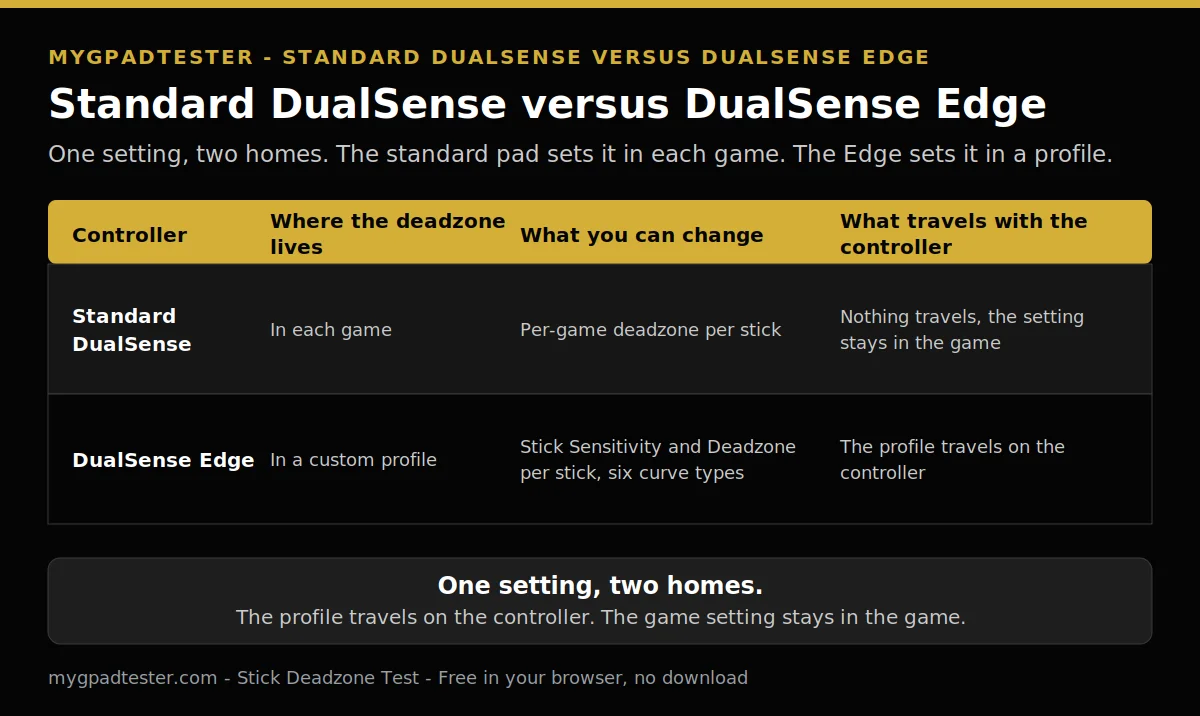
| Controller | Where the deadzone lives | What you can change | What travels with the controller |
|---|---|---|---|
| Standard DualSense | In each game | Per-game deadzone per stick | Nothing travels, the setting stays in the game |
| DualSense Edge | In a custom profile | Stick Sensitivity and Deadzone per stick, six curve types | The profile travels on the controller |
Profiles save to the controller, so they travel with it. Up to three custom profiles plus a default profile can live on the Edge, per Sony PlayStation Support, Tier 2. Create a profile, adjust one stick, save it to the controller, and test in one game before changing anything else. Set the deadzone in the profile first, then use the game’s deadzone setting only if the profile cannot reach the problem.
How do I set PS5 deadzone on PC?
On PC set the DualSense deadzone in the game first, and use Steam Input per game only when the game setting cannot reach the problem. A DualSense Edge can use a PlayStation Accessories app profile on PC instead, and DS4Windows is a third-party route with no behaviour claimed here, so pick one layer and test before adding another.
Steam Input Deadzone runs 0.0 to 1.0, the radius of the central region to ignore, per Valve Steamworks Documentation, Tier 1 and 2. Set it per game, not for all of Steam at once. If the game setting can do the job, leave Steam Input alone. A DualSense Edge can use a PlayStation Accessories app profile on PC instead, per Sony PlayStation Support, Tier 2. DS4Windows is another tool some PC players name for DualSense setup. This post gives it no behaviour, no number, and no recommendation, because no verified DualSense behaviour for it is used in this run.
Close the other tool before testing. If a profile, a game setting, and Steam Input all filter the stick, three filters stack and hide which change helped. Pick one layer, test it, record the result, and only then touch the next layer. The connection is one layer too: wired, Bluetooth, and dongle behave differently on PC, and the USB versus Bluetooth polling comparison explains the connection side. A full Steam deadzone settings post is planned as a spillover post.
What deadzone should I use on PS5 for shooters?
Use the lowest deadzone that keeps a resting stick quiet, starting from your measured resting reading plus 0.01, and set it per game and per stick. No number works for every player, because each stick wears differently, so test in a real match and raise the value only if the stick moves on its own.
Start from your resting reading plus 0.01. That is a tester guide, never a vendor specification. Raise the setting one step at a time, test in a real match after each step, and stop at the lowest value that holds the stick quiet. Zero is not the target, because a stick at rest always carries a small amount of noise.
A deadzone of 10 percent means the stick must tilt beyond 10 percent before the game registers an input. That is an example of what a deadzone means, per Sony PlayStation Support, Tier 2, not a recommended setting, and it is never used here as a target. There is no single best number for PS5, because every stick rests at a different reading.
My DualSense drifts on PS5. Will a bigger deadzone fix it?
No, a bigger deadzone will not fix DualSense drift, because deadzone hides drift, it does not repair it. A bigger value stops visible movement from mild drift but costs fine aim precision, and wear is still there. If the value keeps rising past about 0.20, stop tuning and decide on cleaning or repair.
A bigger deadzone stops the visible movement, but it costs fine aim precision, and the wear is still there. If the value keeps rising past about 0.20, stop tuning. That stop rule is a tester guide, never a vendor specification. Clean the stick, test again in the browser, and decide on repair or replacement.
Test the same controller in the browser tester first. The test procedure lives in How to Test and Visualize Your Controller Deadzone, linked in Related Guides below. If the drift follows the controller to every game, the PS5 drift fix lives in PS5 DualSense Stick Drift Fix, linked in Related Guides below.
Does the DualSense Edge deadzone profile work on PC too?
Yes, a DualSense Edge profile works on PC too, because profiles are saved on the controller, so they travel with it to another PS5 or PC. Create or edit the profile in the PlayStation Accessories app on Windows, and test it in one game on PC before trusting it in a match.
Profiles save on the controller, per Sony PlayStation Support, Tier 2, so they travel with it. No account-sync claim is made anywhere in this post, because profiles live on the controller, not in a PlayStation account. Create or edit the profile in the PlayStation Accessories app on Windows, move the controller, and test the stick at rest on the new device before playing a match. If the aim feels different, the new device filters the stick differently, and the profile may need one more step of adjustment there.
Should I turn off vibration and adaptive triggers when I tune deadzone?
No, you do not need to turn off vibration and adaptive triggers to tune deadzone, because deadzone, vibration, and triggers are separate settings. Tune the deadzone first, then judge vibration and triggers on their own, and never change all three in the same step, because one change at a time is the only way to know what helped.
Vibration is output. Adaptive triggers are input resistance. Deadzone is a stick input filter. The three run on separate settings, so changing one does not change the other. Tune the deadzone first, while vibration and triggers sit at their defaults, then set vibration and triggers to taste.
Some competitive players turn vibration off while they tune, because fewer distractions make the test cleaner. Casual players can leave it on. Either way, judge vibration and triggers on their own, after the deadzone is settled, and change only one thing per test.
How do I set PS5 deadzone step by step, and undo it safely?
Set PS5 deadzone in this order: test the stick at rest in the browser, record the resting reading for each stick, set the game deadzone for one stick, or the Edge profile if you own an Edge, then play one game and retest. To undo it, restore the game or profile default and retune from the measured resting value.
About 30 minutes for the full check sequence, including one match. If the match runs long, allow extra time.
- Browser test at rest. Test the stick at rest in the browser tester, hands off, and watch the reading for a few seconds.
- Record the resting reading. Write down the resting reading for each stick, left and right separately.
- Pick one layer. Pick one layer only: the game setting, an Edge profile, or Steam Input on PC.
- Set one stick. Set one stick from its resting reading plus 0.01, on the layer you picked.
- Play one game. Play one full game and watch small aim corrections at rest.
- Retest. Test the stick at rest in the browser again, and compare the reading with the first test.
- Restore if worse. If the aim feels worse, restore the game default or the profile default, retest one stick at a time, then retune from the measured resting value. Change sensitivity only after the deadzone is settled.
How do I set PS5 deadzone step by step, and undo it safely?
Total Time: 30 minutes
Browser test at rest.
Test the stick at rest in the browser tester, hands off, and watch the reading for a few seconds.
Record the resting reading.
Write down the resting reading for each stick, left and right separately.
Pick one layer.
Pick one layer only: the game setting, an Edge profile, or Steam Input on PC.
Set one stick.
Set one stick from its resting reading plus 0.01, on the layer you picked.
Play one game.
Play one full game and watch small aim corrections at rest.
Retest.
Test the stick at rest in the browser again, and compare the reading with the first test.
Restore if worse.
If the aim feels worse, restore the game default or the profile default, retest one stick at a time, then retune from the measured resting value. Change sensitivity only after the deadzone is settled.
No fix in this post promises a millisecond saving. Each step isolates one change, and the step that clears the problem names the cause.
Related Tools
- Stick Deadzone Test (pillar, highlighted)
- Polling Rate Test
- Button Test
- Trigger Test
- Vibration Test
- Stick Drift Test
- Input Lag Test
- Gamepad Health Checker
Related Guides
- How to Test and Visualize Your Controller Deadzone
- PS5 DualSense Stick Drift Fix
- How to Test Stick Drift Online
About the Author
Marcus Sterling, Lead Engineer and Founder of MyGpadTester, Austin, Texas. Profile: https://mygpadtester.com/marcus-sterling/ X: https://x.com/marcussterlin
On PS5 the deadzone lives in the game, or in an Edge profile saved on the controller. Find the layer first, set it once from a measured reading, and keep the change that holds the stick quiet.
Frequently Asked Questions
Is a DualSense Edge worth it just for deadzone settings?
Only if you want profiles and curves as well. A standard DualSense sets deadzone per game for free, and an Edge adds profiles that travel with the controller. Buy it for the whole package, not for one slider.
Can I use a DualSense Edge profile on a standard DualSense?
No. Edge profiles need an Edge controller, because the profile system is an Edge feature, per Sony PlayStation Support, Tier 2. A standard DualSense sets deadzone per game only.
Does PS5 save deadzone settings per game or per controller?
Per game on a standard DualSense, because the setting lives in each game. On an Edge, the profile saves to the controller and travels with it, so the setting follows the controller, not the game.
Why does my DualSense feel different on PC than on PS5?
Because the layers differ. On PS5 the game and the Edge profile filter the stick; on PC the game, Steam Input, and the Accessories app can each filter it. Test the same controller in the browser tester on PC first, then compare one layer at a time.
Does changing deadzone affect adaptive triggers or haptics?
No. Deadzone filters the stick input, while adaptive triggers change trigger resistance and haptics are vibration output. They are separate systems, so tune the deadzone first and judge the others on their own.
What if my DualSense still drifts after a reset and a 0.20 deadzone?
Stop raising the deadzone. Reset the controller per Sony, clean the stick, test again in the browser, and decide on repair or replacement. The PS5 drift fix post is linked in Related Guides.
On PS5 the deadzone lives in the game, or in an Edge profile saved on the controller. A standard pad takes the game setting. An Edge takes the profile. One layer at a time, set from a measured resting reading, is the whole method. Run the browser test again any time on MyGpadTester.
Next Steps
Test the stick again with the Stick Deadzone Test, then work the steps in order. Read How to Reduce Controller Input Lag on PC for the PC lag fix order. Read Best Deadzone Settings for FPS for the full per-game settings table. Read Xbox Deadzone Settings for the Xbox platform route.